
“OUR EUROPEAN NEIGHBOURS ARE AN INDISPENSABLE PART OF OUR FUTURE STRATEGY”
In this interview, Christian Zaum, Düsseldorf's Head of Economic Affairs, talks about the importance of markets in Europe, the Middle East and Africa (EMEA), economic neighbourhoods, and new dynamics in the state capital's business environment.
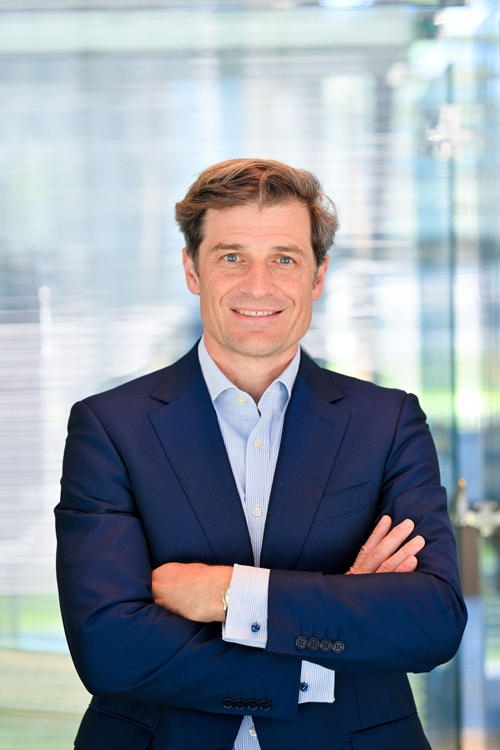
Christian Zaum, Head of Economic Affairs, City of Düsseldorf
Mr Zaum, let's start with Düsseldorf's closest neighbour. What role does France play for Düsseldorf as a business location?
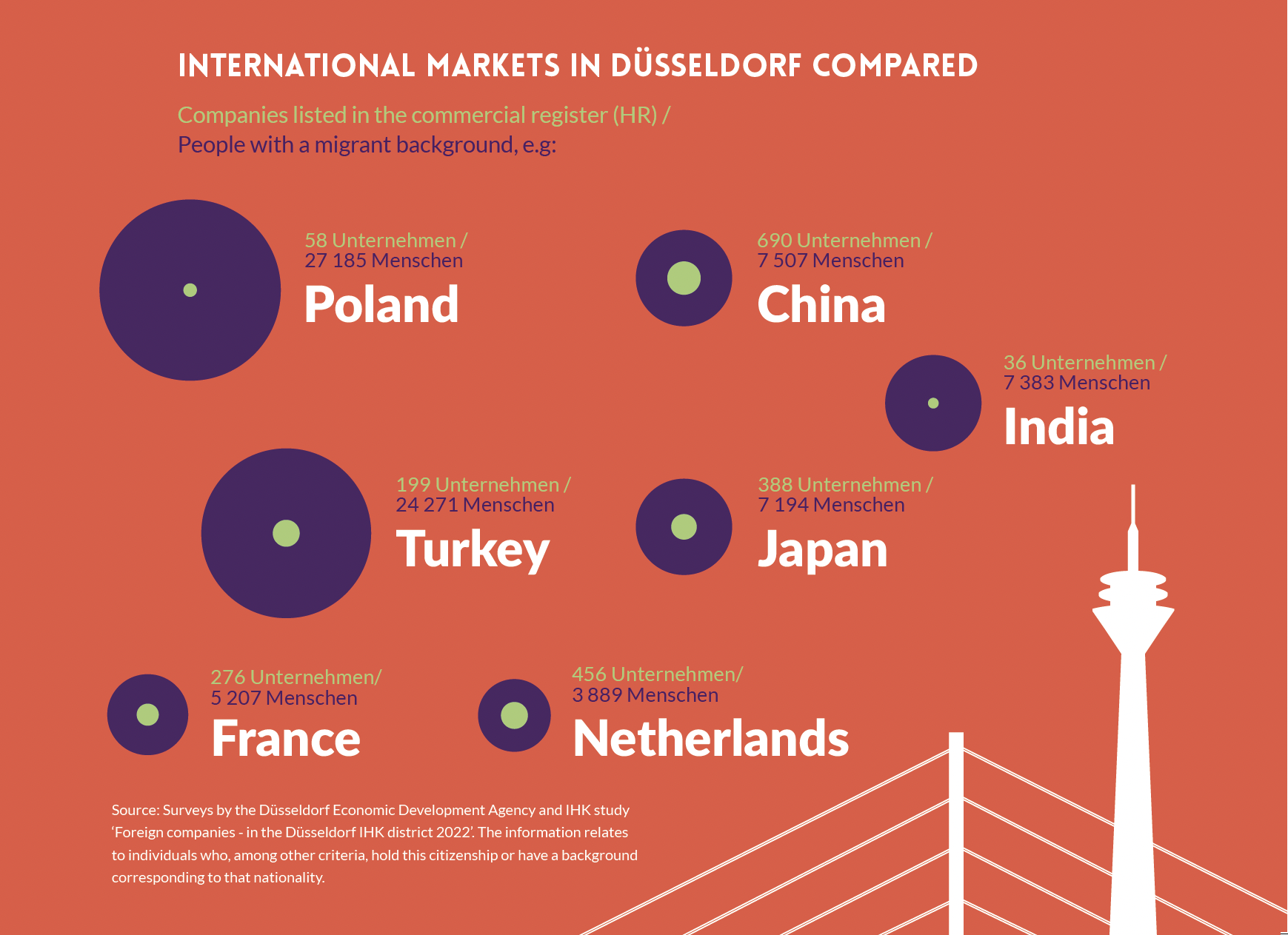
France is a key partner for us, both economically and culturally, as well as historically. Close ties were forged between the Rhineland and France during the Napoleonic era, and even today, the Rhineland mentality fits in well with French savoir-vivre. It is and remains a ‘people's business’, in which trust and personal relationships play a major role. Currently, there are 276 French companies operating in Düsseldorf, as well as around 100 smaller businesses. These include major players such as L'Oréal, which has its DACH headquarters here, Targobank, the video game specialist Ubisoft, the IT service provider Atos, the gas manufacturer Air Liquide, and the two energy technology companies Schneider Electric and Spie, both of which recently moved to the Euref Campus. We have a wide range of companies, from large corporations to technology-oriented medium- sized businesses. One particularly exciting area is the startup scene. The La French Tech initiative has been active in Düsseldorf for two years, providing a lively connection between French founders and our local tech community. Last autumn, the French Tech Awards were held here, attended by the French ambassador. This sent a clear message that Düsseldorf is a key player in the European innovation network.
But what about our smaller western neighbours, the Benelux countries?
The focus here is clearly on the Netherlands, with Belgium and Luxembourg playing a rather subordinate role. However, it should be emphasised that Luxembourg will host the 2027 EuroSkills European Championships for apprentices (see info box). Nevertheless, the economic ties with the Netherlands are significant. We are direct neighbours, and this proximity is evident in many areas. For example, there are 816 Dutch companies in Düsseldorf, 600 of which are listed in the commercial register. This puts us at the top of the national rankings. Many of these companies manage their German or DACH business from here. Interestingly, in 2024, Düsseldorf Airport was voted the most popular Dutch airport by the Dutch travel portal ‘vakantiediscounter,’ which demonstrates the strength of these ties. Major players include the delivery service Picnic, FrieslandCampina, which owns the Landliebe brand, and the insurer Dela. The retail chain Action, which is currently expanding rapidly, also has a strong presence. Many new companies from the Netherlands and France that have settled here in recent years operate in the green tech sector. Sustainability and technology are currently the two main themes.
EUROSKILLS 2027 IN DÜSSELDORF
EuroSkills is Europe's largest event for vocational training and excellence. From 22 to 26 September 2027, around 800 young top professionals from all over Europe will meet in Düsseldorf to compete in 50 disciplines – from crafts and industry to services. 150,000 visitors are expected. For the first time, Germany and Luxembourg are jointly hosting the European Professional Championships. Under the motto ‘SKILLS! Shape Your Future’, the aim is to inspire young people with the diversity of modern apprenticeship professions – both at the competition venue and in crossborder activities in the run-up to the event.
EUROSKILLS2027.COM
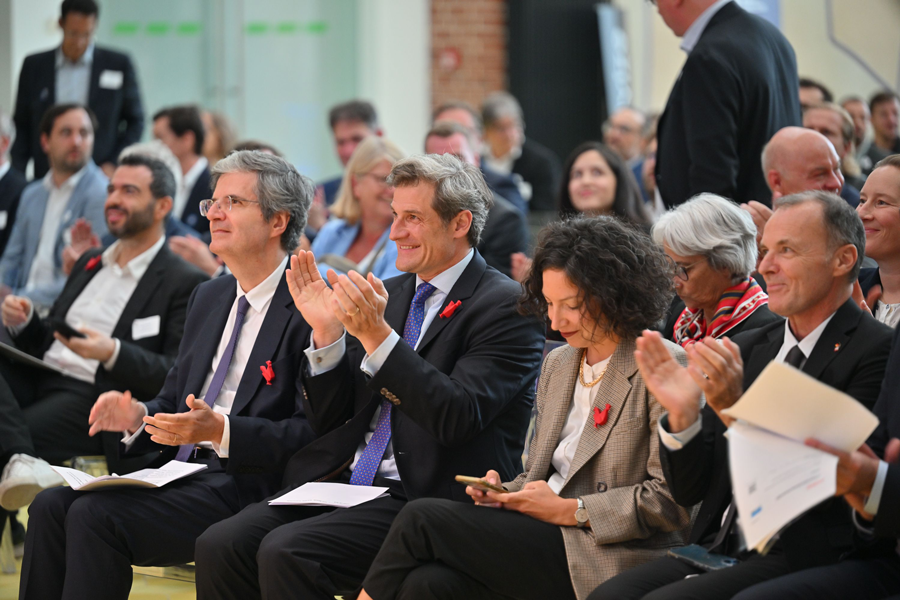
Düsseldorf's Head of Economic Affairs Christian Zaum at the La French Tech Award 2025.
The UK is a special case after Brexit. How has the situation developed here?
The UK remains a very important market. We have around 700 British companies in Düsseldorf, including Vodafone, HSBC, and the property developer Segro. After Brexit, many cities in continental Europe hoped that significantly more companies would leave the UK. This did not happen. However, Düsseldorf specifically sought to attract new companies and has managed to maintain its position. We are now seeing more momentum again. After the difficult period following Brexit and the pandemic, British companies are picking up speed again.
But what about our northern neighbours in Scandinavia?
Scandinavia is becoming an increasingly exciting region for us. Delegations visit regularly, particularly from Sweden, primarily from the clean tech and start-up sectors. As part of an accelerator programme, ten Swedish startups visit Düsseldorf every year to familiarise themselves with the German market. Although the number of Scandinavian companies here is still relatively small, the quality is high. Examples include Statkraft, a Norwegian energy company, and Neste from Finland, which develops synthetic fuels and kerosene substitutes. Clearly, the topics of sustainability, energy and technology are common threads running through the city's international relations.
Another focus seems to be Eastern Europe, particularly Poland. Why is that?
Poland is indeed a very important partner for Düsseldorf. The two cities have been twinned for 35 years, so economic relations are based on a long tradition. Additionally, there is a sizeable Polish community in Düsseldorf: around 27,000 people have Polish roots, and 8,000 of these individuals hold Polish passports. The Polish community has 2,000 small businesses and is the largest in the Chamber of Industry and Commerce district. Many of its members work in skilled trades and the construction industry. However, there are also innovative, growing companies: Mod21 builds modular wooden houses; Coding Giants offers programming courses for young people; and PW Krystian is a manufacturer of protective workwear that regularly exhibits at the A+A trade fair. We promote exchange through initiatives such as the German-Polish Business Days and the German-Polish Business Dialogue. It's not just about new businesses setting up shop; it's also about Düsseldorf companies getting involved in Poland: Metro, Henkel and Ergo, for instance, are highly active there. We support this exchange through delegation trips and specialist workshops in collaboration with the AHK Poland.
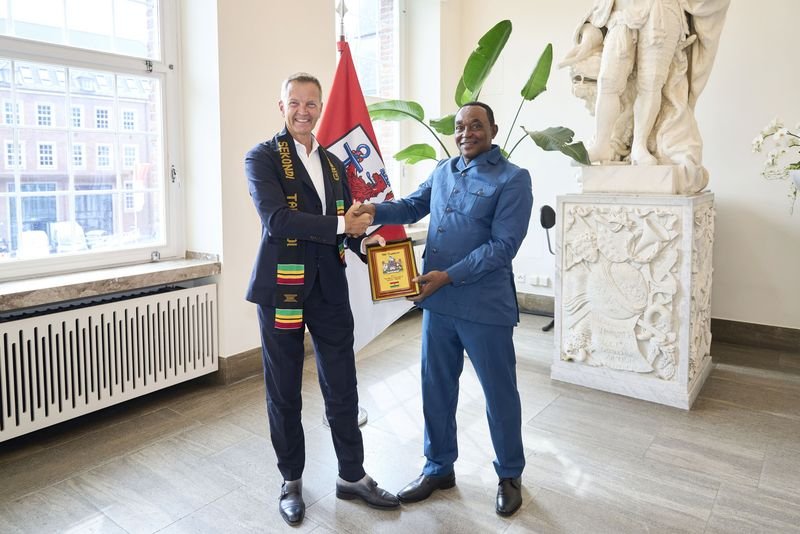
Mayor Hinkel with Frederick Fausto Faido, Mayor of Sekondi-Takoradi, Ghana, on Monday, 8 September 2025, in the Jan Wellem Hall of City Hall.
How important are countries from the Middle East, such as Turkey and Israel, for Düsseldorf as a business location?
Turkey plays a prominent role. With around 13,000 Turkish nationals living in Düsseldorf, they form the largest foreign population group. This is also reflected in the economy, with 842 Turkish companies active in the city, around 200 of which are listed in the commercial register. This makes Turkey the second-largest foreign business group in Düsseldorf after the Netherlands. Many of these companies operate in trade, construction, and the service sector. One example of an active partnership is the ATIAD association, which is based in Düsseldorf and organises the German-Turkish Business Day. This high-profile event brings together political and business representatives from both countries. Israel, on the other hand, has close links with us, primarily through our town twinning with Haifa. In recent years, we have made numerous delegation trips, particularly in the areas of IT, security and startups. However, due to the current political situation, visits have been reduced. However, our contacts remain in place and are long-term.
What role does Africa play at the moment?
It is not yet a focus for us, but there are promising initial approaches. The Moroccan Consul General here in Düsseldorf is particularly active in this regard. We have also recently formed a partnership with Sekondi-Takoradi, a city in Ghana. A Düsseldorf delegation visited in November to explore potential areas of collaboration. While these are isolated cases for now, such contacts could become more important in the medium term.
What does this mean strategically for the coming years?
We are not currently planning to focus on or open desks in any new countries. The key is to strengthen existing relationships and invest specifically where there is noticeable momentum. This primarily means the Netherlands, France, Poland and Turkey. These four markets are central to our operations in the EMEA region. However, it is important to me that we do not underestimate the significance of Europe as a whole. When people talk about internationalisation, they often think of China, Japan, India or the USA first. However, our European neighbours are more closely economically intertwined with Düsseldorf than many realise. This makes them an indispensable part of our future strategy. •
Words: Tom Corrinth
Pictures: Wirtschaftsförderung Düsseldorf/Michael Lübke, Landeshauptstadt Düsseldorf/Claus Langer