
TRADITION AND TRANSFORMATION
GEA is one of the world's largest system suppliers for the food, beverage, and pharmaceutical industries. Originally founded in Frankfurt at the end of the 19th century, the group is now headquartered in Düsseldorf-Derendorf and is one of Germany's 40 largest listed companies.
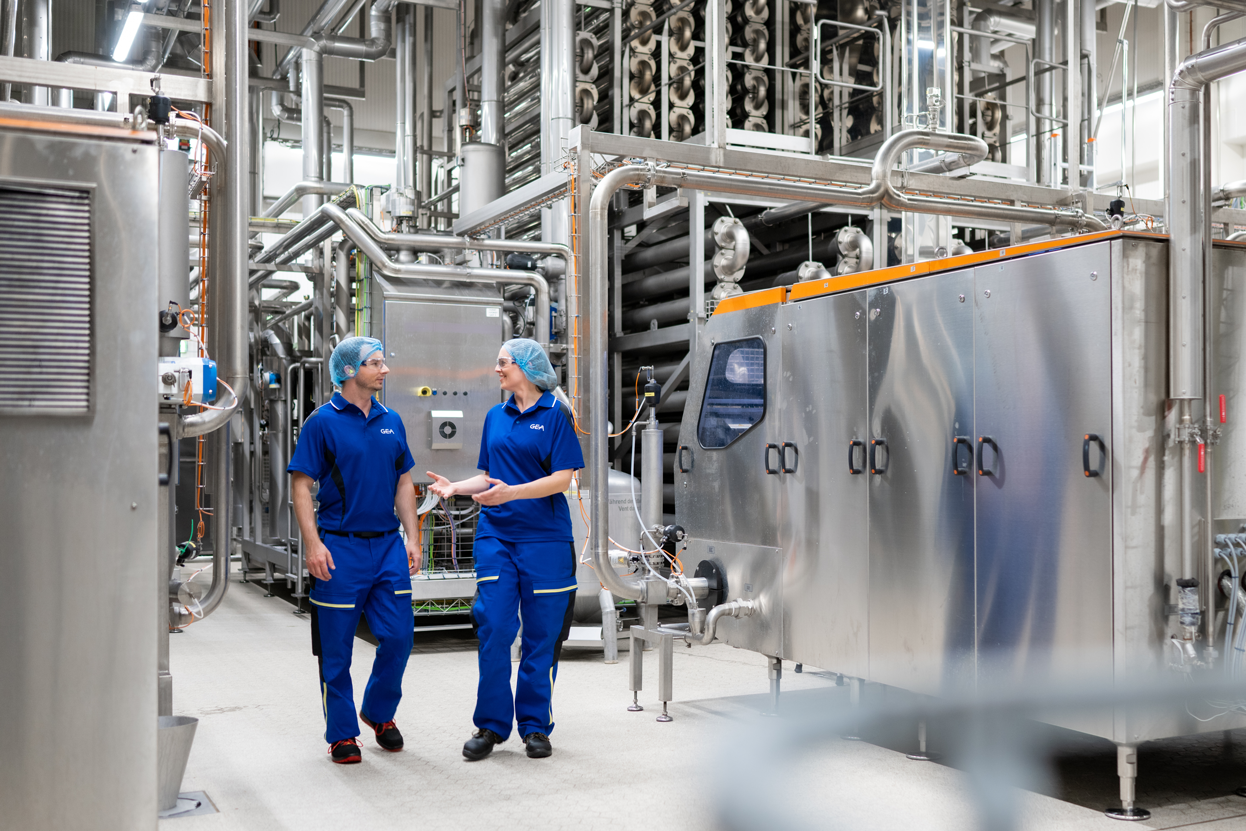
From milking robots to dairy processing lines: a quarter of all processed milk passes through GEA systems, such as here at the Hochwald dairy in Mechernich.
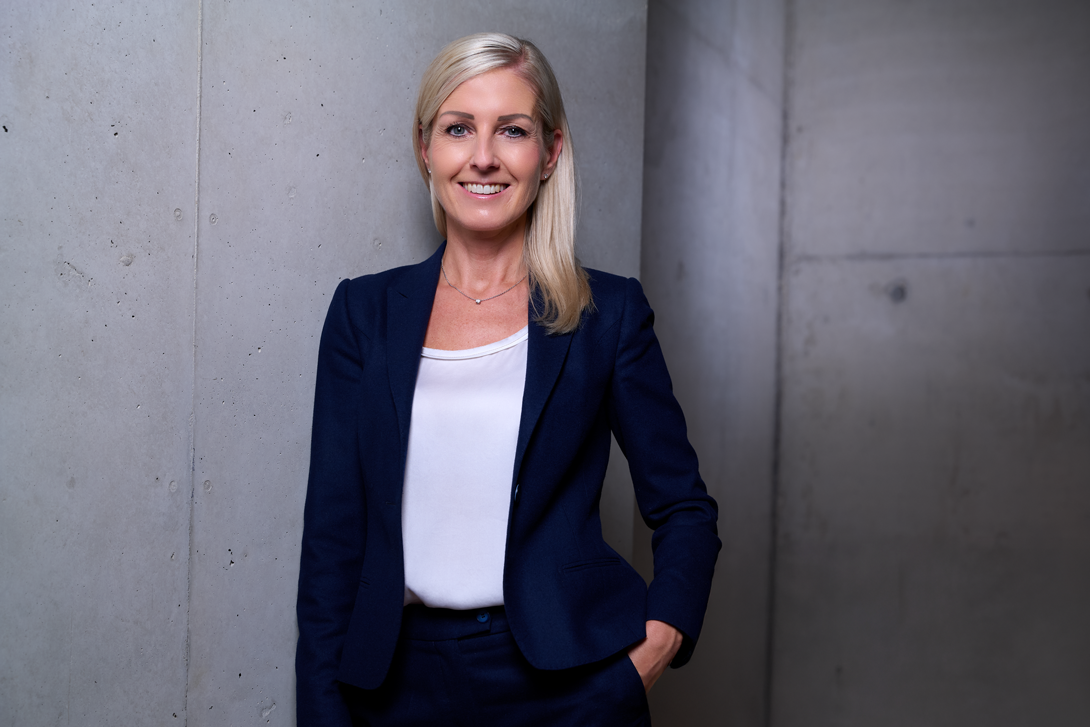
Dr. Nadine Sterley, Chief People & Sustainability Officer, GEA
GEA's rich history dates back to 1881, when the company was founded as Metallgesellschaft AG (MG) in Frankfurt am Main. The company quickly expanded its portfolio to include trading in chemicals and building plants to process iron and extract non-ferrous metals. As demand for metal increased in Germany, MG did more and more business with other countries, founded its own bank, and entered the shipping business in the 1920s. This laid the foundation for a corporation that would operate globally and survive several historical and economic crises, upheavals and internal restructuring in the following decades, while continuing to develop its services and product range. In 1999, MG finally merged with GEA, a rapidly expanding group from Bochum which later became its namesake. This merger created a global engineering company that supplies machinery and plant technology to customers in a wide range of industries. In September 2025, GEA joined the DAX. It is now one of Germany's 40 largest listed companies, with over 18,000 employees and annual sales exceeding five billion euros in more than 150 countries.
Based in Düsseldorf since 2011, the group's portfolio includes not only machinery and equipment — from homogenisers, mixers, pumps and spray dryers to tablet presses — but also modern process technology, components and services primarily used in the food and pharmaceutical industries. "Many people are not familiar with our name in their everyday lives, but they encounter our technology constantly behind the scenes." For example, one in four packets of pasta and one in two litres of beer worldwide are produced using GEA technology. We also supply every second pharmaceutical separator for essential health products such as vaccines or novel biopharmaceuticals," explains Dr Nadine Sterley, Chief People & Sustainability Officer and member of the GEA Executive Board since 1 January 2026. "In the food and beverage industry, energy, water, raw materials and waste directly impact competitiveness," Sterley continues. Sustainability is not an add-on, but a measurable impact in day-to-day operations.
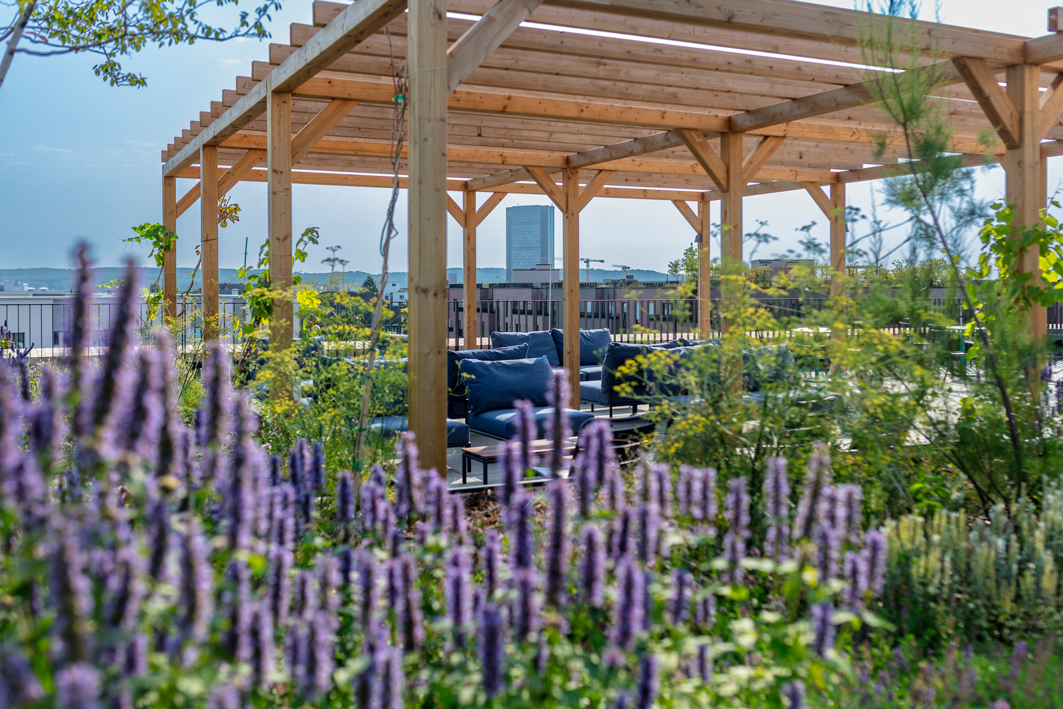
Last year, GEA moved into its new headquarters in Düsseldorf-Derendorf. The roof terrace is a green retreat with a fantastic view.
GEA is also focusing on this issue internally and aims to contribute positively to society and the environment. "Our climate goal is net zero by 2040. To this end, we have drawn up our Climate Transition Plan 2040, which sets out clear levers and measures along the entire value chain." This starts with reducing our own emissions consistently. "We are investing around 175 million euros in decarbonising our sites by 2040. This involves phasing out fossil fuels, electrifying our vehicle fleet, expanding our own renewable energy production, and increasing the energy efficiency of our production processes and buildings," explains Nadine Sterley.
GEA also takes its supply chain and partners into account. The Group considers its social responsibility to be equally important. "As a listed company, we have a responsibility to our employees, our locations, our supply chains and society. For me, this starts in-house — with good working conditions, safety, development opportunities, and a clear commitment to integrity," says Nadine Sterley. At the same time, the company naturally wants its social responsibility activities, such as those of the GEA Foundation, to have a certain external impact. The Foundation aims to donate one per cent of the Group's net profits to STEM education, children in need, infrastructure access and disaster relief.
Economic efficiency should not be neglected either. GEA has launched a strategy called "Mission 30" to address this. The goal is growth, profitability and a significantly greater impact. "A key indicator is that the proportion of sales generated by our sustainable solutions should rise to over 60 per cent by 2030, up from 41.5 per cent in 2023," says Nadine Sterley.
Other key issues for modern companies these days are digitalisation and, above all, AI. "They make plants and processes easier to control in everyday use, resulting in less downtime, more consistent quality, and reduced resource consumption." Nadine Sterley believes that networking is a crucial step in this process: by 2030, GEA aims to connect around 80 per cent of its installed base, more than 35,000 machines. This will generate data that can be used to create new services.
Nadine Sterley does not fear that such digitalisation measures could jeopardise jobs – quite the contrary. "Digital systems are changing job profiles, as we are already seeing with our customers today. In many production facilities, skilled personnel are in short supply while systems are simultaneously becoming more complex. Digitalisation helps to make operations more stable, easier to run and more predictable. This takes the pressure off teams and supports training and development rather than replacing it," she explains.
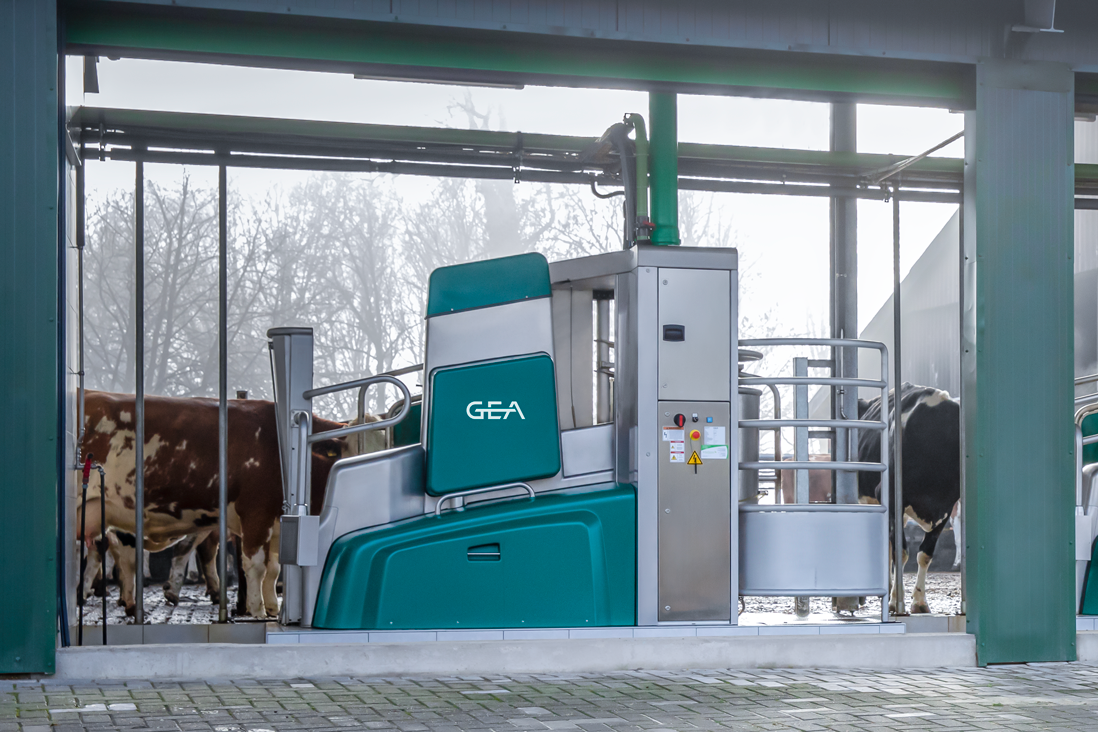
A GEA Dairy Robot R9500 in action, designed to ensure an optimal milking process, enable more flexible time management and improve cow health.
A corporate philosophy based on values is therefore important to GEA on several levels, not least because of its long history. "GEA has grown over time. Our values compass is our guiding principle. It ensures that decisions, both internal and external, remain consistent. Expectations of our daily actions include responsibility, integrity, diversity, passion and excellence," says Nadine Sterley.
This may be one reason why GEA wants to stick to its core competencies. "Our most important markets are food, beverages, and pharmaceuticals. That will remain the case." Moving from Bochum to Düsseldorf in 2011 was also a strategic decision, and GEA has been based at its new headquarters in Derendorf since August last year. "Düsseldorf has good international connections and is close to important networks. The new headquarters brings central teams under one roof. This speeds up coordination, simplifies interfaces, and strengthens a culture based on dialogue, personal responsibility, and openness. This is exactly how we need to work in order to become faster," says Nadine Sterley confidently. •
Words: Katja Vaders
Pictures: GEA/Mike Henning, GEA/Frank Beer, GEA/Ansgar M. van Treeck