SUSTAINABLE ADVERTISING
In 2020, the EU examined environmental claims made by companies and found that half of them were either unverifiable or unsubstantiated. Product information is therefore now to be regulated uniformly through a directive. For companies, this means one thing above all – a need for advice.
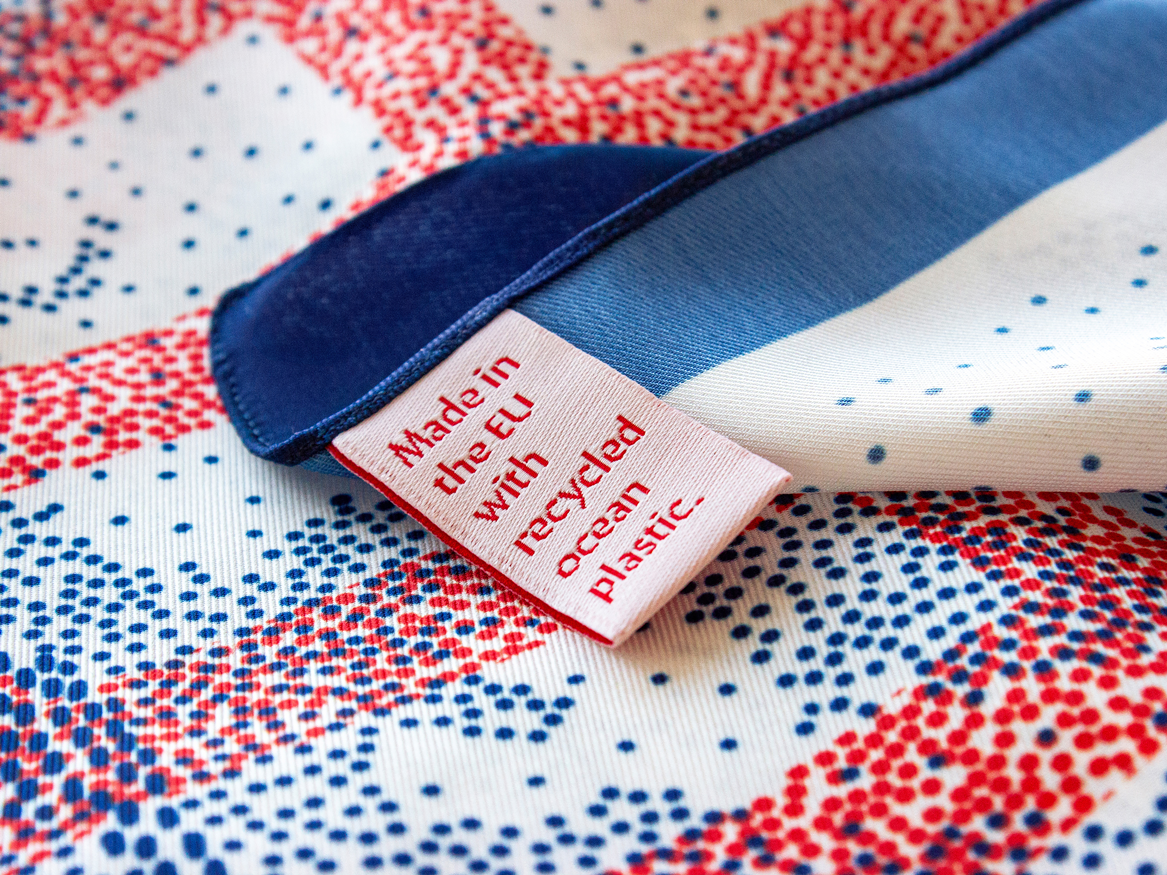
A ‘furoshiki’ is a reusable cloth used in Japan to wrap gifts. This one is made from ocean plastic and was developed by the Peter Schmidt Group.

Ina Kamps is a lawyer specialising in trademark and competition law; she advises companies on the new EU EmpCo Directive and runs workshops on the subject.
“Climate-neutral”, “made from 100% recycled materials”, “environmentally friendly” – these and similar claims are found in numerous advertising campaigns or on product packaging these days. Nevertheless, it is not always clear to consumers to what extent such promises are credible. “This is a problem that the EU has now addressed by introducing two new directives to regulate sustainability claims: the Empowering Consumers (EmpCo) Directive and the Green Claims Directive,” explains Ina Kamps, a lawyer specialising in trade mark and competition law. The expert in sustainable corporate communications regularly holds workshops, as she did recently as part of the Düsseldorf Climate Pact.
The background to these two directives is a study of advertising in the environmental sector carried out by the EU in 2020. “The study found that over 50 per cent of the claims examined were either incomprehensible or unsubstantiated, and over 40 per cent were unverifiable,” Kamps continues. The EmpCo Directive and the Green Claims Directive are intended to regulate advertising claims uniformly across the EU in future, so that consumers can better navigate the jungle of environmental labels and promises. However, the extent to which the Green Claims Directive has been actually implemented is currently unclear. One reason for this is the overly strict bans and requirements on environmental advertising, which go beyond the EmpCo regulations and are virtually impossible to implement in practice. “There would be a requirement for prior assessment of environmental claims. The whole thing would be an immense bureaucratic and financial undertaking,” says Ina Kamps. This is particularly disproportionate for small and medium-sized enterprises – one reason why the directive is apparently not being pursued at present; in fact, the exact state of affairs is currently unknown.
That leaves the EmpCo Directive, which will come into full effect from autumn 2026. “Very general terms that are not explained in detail may no longer be used in future. A statement such as ‘energy-efficient’ would then have to be specified either within the statement itself or, for example, by being marked with a visible asterisk, such as ‘We use 100 per cent green electricity in the manufacture of this product’,” explains Ina Kamps.
The regulations affect companies across all sectors, with the need for change being particularly significant in the food and cosmetics industries. However, the textile industry also frequently uses sustainability labels that are difficult to verify. “From September, all labels must be third-party certified. Until now, the market has been dominated by many self-awarded labels that have not been independently verified and which consumers find hard to assess. Therefore, a key aim of the regulation was to ensure that unverified self-claim or self-awarded labels become a thing of the past.” Ina Kamps advises companies on the best way to comply with EU regulations. In her experience, most of them want to make advertising claims that are transparent and, above all, accurate. Her initial concern that so-called ‘green hushing’ might set in – that companies would stop advertising their environmental commitment because it became too complicated for them – has fortunately proved to be unfounded.
In her workshops, Ina Kamps advises first taking stock of all advertising claims and packaging texts relating to sustainability and then comparing them with the requirements coming into force in September. She also recommends seeking legal advice. This is also advisable when it comes to forward-looking environmental claims, which, from September onwards under the EmpCo Directive, will only be permitted if accompanied by a detailed implementation plan with timelines and resource allocation. “Companies face many challenges in avoiding potential warnings or damage to their reputation. They must therefore examine carefully the context in which the claim is made,” says Ina Kamps.

Laura Ullmann is Design Director at the Peter Schmidt Group and helps brands place the right look in the right context.
Placing the right look in the right context – in other words, designing logos and packaging that reflect a brand’s values – is one of the core tasks of the Peter Schmidt Group. It is one of Europe’s largest brand and design agencies, part of the international Omnicom network, and has offices in Düsseldorf on Königsallee, amongst other locations. “Our sister agencies in Düsseldorf have joined the Climate Pact to help achieve the city’s climate targets,” says Laura Ullmann, Design Director at the Peter Schmidt Group. Sustainability is a fundamental issue throughout the advertising and marketing industry, as well as in our exchanges with the other agencies in the network.
The Peter Schmidt Group serves a large and diverse client base for whom sustainability issues are also becoming increasingly important. “Broadly speaking, our work can be divided into the areas of corporate branding and consumer branding: corporate branding covers brand identities for international clients, whilst consumer branding encompasses the whole field of packaging design – and it is precisely here that sustainability issues are of paramount importance,” explains Laura Ullmann. On the one hand, this concerns the sustainability of the packaging itself, such as requirements for its recycling or potential material savings, but also the contents of the products and the question of whether they are sustainably produced, organic, regional or fair trade. “This information is important for communication, as consumers use it as a guide,” says Laura Ullmann. Nevertheless, she feels that brands’ sustainability claims are harder for consumers to understand than ever before. She does not believe that the EmpCo Directive and the Green Claim Directive can solve this problem simply and quickly. “A guideline always remains general. Every single company – and therefore our customers, too – now faces the challenge of interpreting with regards to their specific situation.” Drawing on its marketing expertise, the Peter Schmidt Group team therefore aims to provide its clients with comprehensive advice and support in implementing the guidelines correctly. Laura Ullmann believes the guidelines are necessary, as unregulated communication only serves to cause confusion. She does not believe that the regulations complicate sustainability communication. “The opposite is true! Greenwashing is currently a common practice and leads to consumers losing trust in the issue of sustainability. It is primarily those companies that are sincere about it that suffer as a result. The new legal regulations give genuinely sustainable brands – and only them – the opportunity to stand out from the competition.” •

Text: Katja Vaders
Pictures: Peter Schmidt Group, Michael Lübke