FRESH IDEAS FROM DÜSSELDORF (Kopie)
The blossoming of Düsseldorf into a German startup hub is also due to the success of Startup Week. From 7 to 11 September 2026, startups, investors and companies once again came together to share knowledge and inspire one another at this year's event, which came to a close just as we went to press. Around 9,000 people attended! Highlights of the programme included the Female Founders Summit, ERGO Pitch Party Vol. 2, Day-One Venture Night Vol. V, and of course, Future Tech Fest 2026 – Germany’s leading B2B startup trade fair and conference. A total of 93 events covering a wide variety of topics were on the agenda. The three startups we’re featuring in this issue – LearnSlices, navou and rh:ool Yarn – have probably already experienced this Düsseldorf institution first-hand. Happy reading!
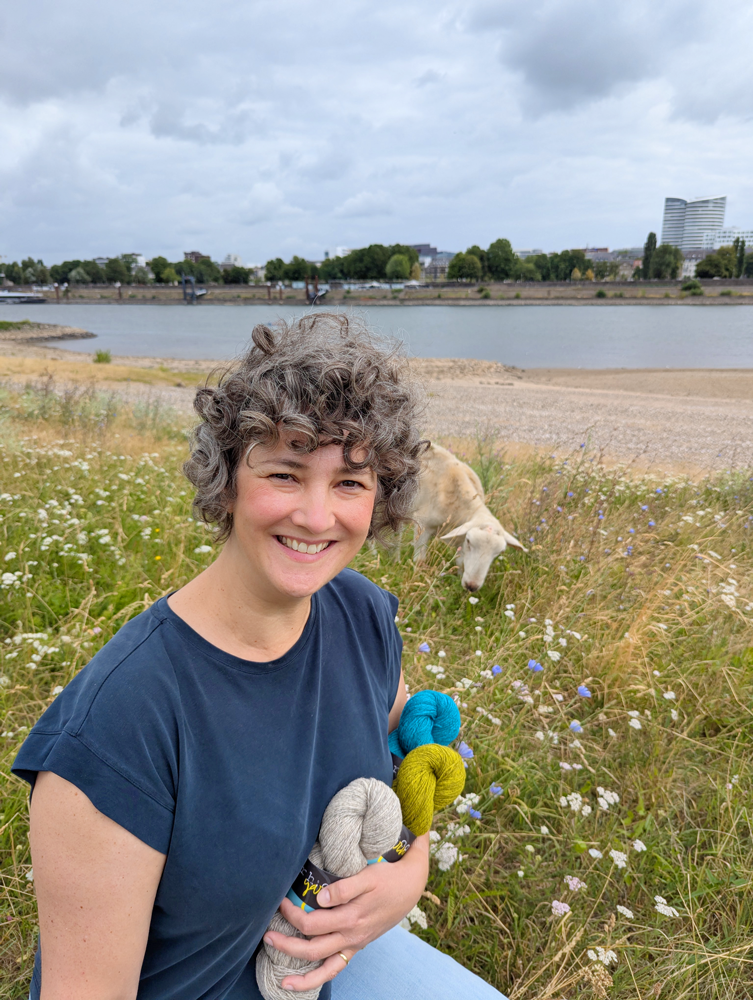
Combining regional wool with handcrafted work: Frieda Feld of rh:ool Yarn.
FROM DÜSSELDORF SHEEP TO FAVOURITE JUMPERS
Wool is a valuable raw material, yet in Germany it is often poorly paid for or even thrown away. The Düsseldorf- based rh:ool Yarn project aims to change that. It was founded by the passionate spinner Frieda Feld in June 2021, after she first held this raw material in her hands while shearing sheep in the Rhine meadows in Düsseldorf. In February 2022, she began selling products in her online shop. “I find the idea of creating something from scratch and championing resource recycling very fulfilling,” says the founder. However, she also notes how difficult it is for craftspeople to source regional wool and trace its origin. rh:ool Yarn therefore also aims to connect shepherds with the craft community more effectively.
Customers can find out where the wool comes from and, in the case of the Düsseldorf flock, they can even knit a jumper from 'their' own sheep. The initiative also raises awareness of the fact that shepherds often receive only a few cents for their wool, whilst shearing costs around €3.50 per sheep. “Wool isn’t waste. It’s a raw material that we need to learn to value again,” says Frieda. Her message is clearly resonating with people: her fan base is growing, and in 2023, she added a flock from Cologne’s green belt. This year, she has added a third flock from Kandel. Frieda doesn’t see other small businesses marketing regional wool as competition, but as a sign that things are moving in the right direction. The sheep on the Rhine meadows have become local celebrities, and their wool is now sold nationwide. “You can do something like this anywhere. But knitting a jumper from the wool of sheep right on your doorstep naturally has a special appeal,” says Frieda. •
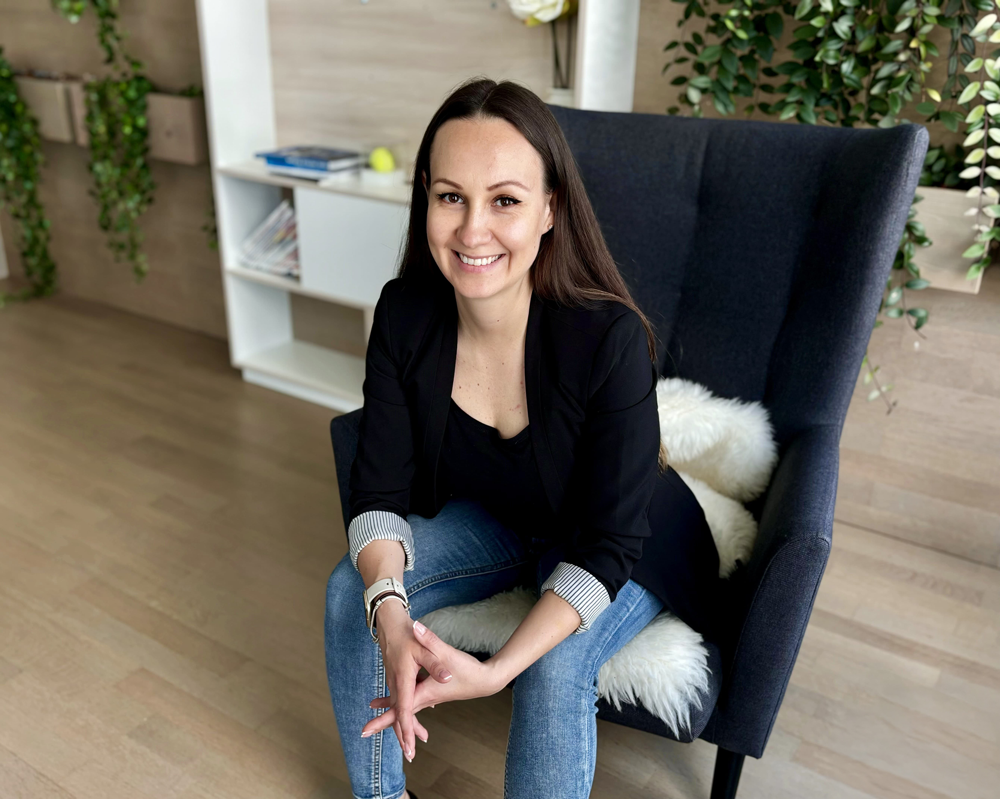
Founder of the AI mentor platform LearnSlice: Alesia Kunz.
AI MENTOR FOR CAREER STARTERS
As a lecturer in vocational training, Alesia Kunz repeatedly observed the same pattern: trainees often lack direction at the start, while trainers often lack the time to provide close guidance. "In many companies, vocational training takes place alongside day-to-day business. This structural problem is costing Germany skilled workers,” she says. Rather than hiring more staff, she believes the solution lies in technology that supports people with routine tasks and frees them up for value-adding work. In 2025, she therefore founded the AI mentor LearnSlice. The platform supports users from Chamber of Industry and Commerce (IHK) exam preparation through to continuous upskilling, offering personalised onboarding and a company-specific wiki. The AI creates personalised learning pathways based on the user’s role and company context, combining knowledge with practical tasks and career coaching. These can also be based on the company’s own internal materials.
The aim is to help junior staff become productive more quickly whilst enabling experienced teams to reclaim time for tasks where human support is crucial. According to LearnSlice, initial proof-of-concept trials with large companies in the industrial and technical sectors have produced significant results: trainers save up to 50 per cent of their supervision time and trainees become operational up to 65 per cent faster. “AI takes care of the repetitive tasks, while people handle the important interactions,” says Kunz, describing the principle. Over the coming years, LearnSlice's primary focus will be on reaching small and medium-sized enterprises. Düsseldorf offers direct links to the business community, universities, chambers of commerce, and funding bodies. “We want to prove that AI does not replace skilled workers, but rather enables them in the first place,” says Alesia Kunz. •
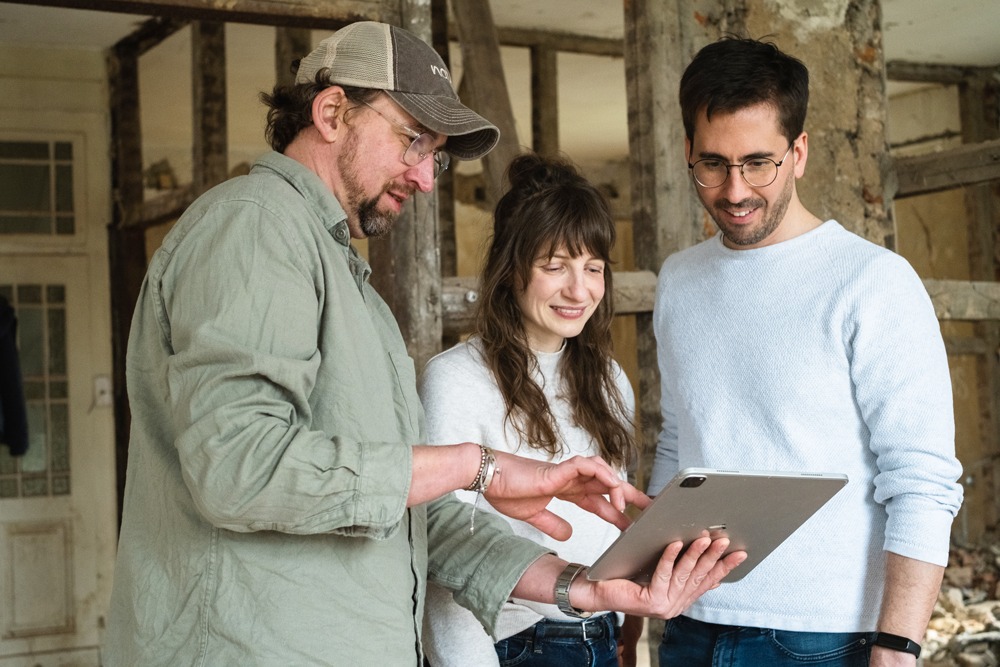
Mit dem Startup navou machen Sebastian Rademacher, Lisa Weise-Hoff und Mario Schmoltzi Gebäudeumbau planbarer (v.l.n.r.).
FROM VACANT PROPERTY TO HOUSING
Germany has a shortage of flats, yet at the same time there are millions of square metres of vacant or underused buildings. This is precisely the contradiction that Düsseldorf-based startup navou, founded in 2024, is tackling. The founding team — Mario Schmoltzi, Lisa Weise-Hoff and Sebastian Rademacher — has experience in investment banking, management consultancy, entrepreneurship and construction planning. “We want to make building conversion predictable,” says Lisa. This is because it often remains unclear for months on end, particularly with problematic vacant properties, whether a change of use is even worthwhile.
navou analyses much more quickly whether and how an existing building can be converted into energy-efficient living space. This includes an initial indication of costs and feasibility, before any expensive planning work is undertaken. This benefits property owners, project developers and local authorities, and navou then supports the implementation with standardised conversion concepts. 'We’re rethinking the refurbishment process and breaking down the silos between planning and execution,' explains Sebastian Rademacher.
navou is currently participating in the fourth cohort of the Prop- Tech accelerator ATechX, and is planning a ‘office-to-residential’ pilot project in collaboration with a major European property owner. The startup is also working with well-established industrial and construction companies, such as Würth, on joint product development. The aim is for the digital feasibility assessment to become the standard tool for the initial evaluation of conversion potential. The conversion concepts are to be used by partners as licensable solutions. “Where vacant properties and the demand for housing intersect, we want to start across Germany first, then across Europe,” says Lisa Weise-Hoff. Düsseldorf is the ideal starting point for this: North Rhine-Westphalia has a particularly large number of existing buildings, high housing demand and a dense network of property companies, developers and investors. •
Text: Tom Corrinth
Pictures: privat, navou_House of Yas