
”FOR ME, COFFEE IS A WAY OF UNDERSTANDING THE WORLD”
KUNST MEETS MARTIN SCHÄFER
He started out with a café in Düsseldorf, now he travels halfway around the world and jumps out of planes with a parachute: Martin Schäfer is the co-managing director of Rösterei Vier, working with farmers from Costa Rica to Malawi. VIVID editor Rainer Kunst spoke to him about entrepreneurship, the challenges posed by climate change, the cultural significance of coffee – and how a zip-lock bag can sometimes determine the course of a life.
How did you get into coffee?
Coffee has always been ‘my thing’. While studying business administration in Münster, I worked in cafés to earn extra money. To be honest, I often found that more exciting than statistics or accounting. I just had a knack for being a host. After graduating, eager to see the world, I set off with a round-the-world ticket. While working in a fast food restaurant in Vancouver, I realised that I was leaving 15 minutes earlier in the morning just so I could stop at one of the many cafés en route for a coffee. The same thing happened on my way back in the evening. That's when I thought, 'That's exactly what we need at home: a coffee culture like this.' Then, in the mid-1990s, I started developing the idea for a café and went into business for myself.
But where does this entrepreneurial spirit come from?
I sometimes ask myself that question. I never got to know my two grandfathers, but I did know my greatgrandfather. As a baker's apprentice, he travelled from Duisburg to Venice in 1912, for example. He had a very strong personality that left a lasting impression on me. Perhaps this entrepreneurial spirit comes from him. But I think my desire to be a host is mainly my own. Even at school, I organised New Year's Eve parties. This desire to 'bring people together' has stayed with me to this day. And, of course, there's my love of travel: I spent a long time travelling around Australia, back when there was no influx of German backpackers. Many of the students working for us, went there too, and that creates a bond.
You spend about half the year travelling around the world for work. Was it always like that?
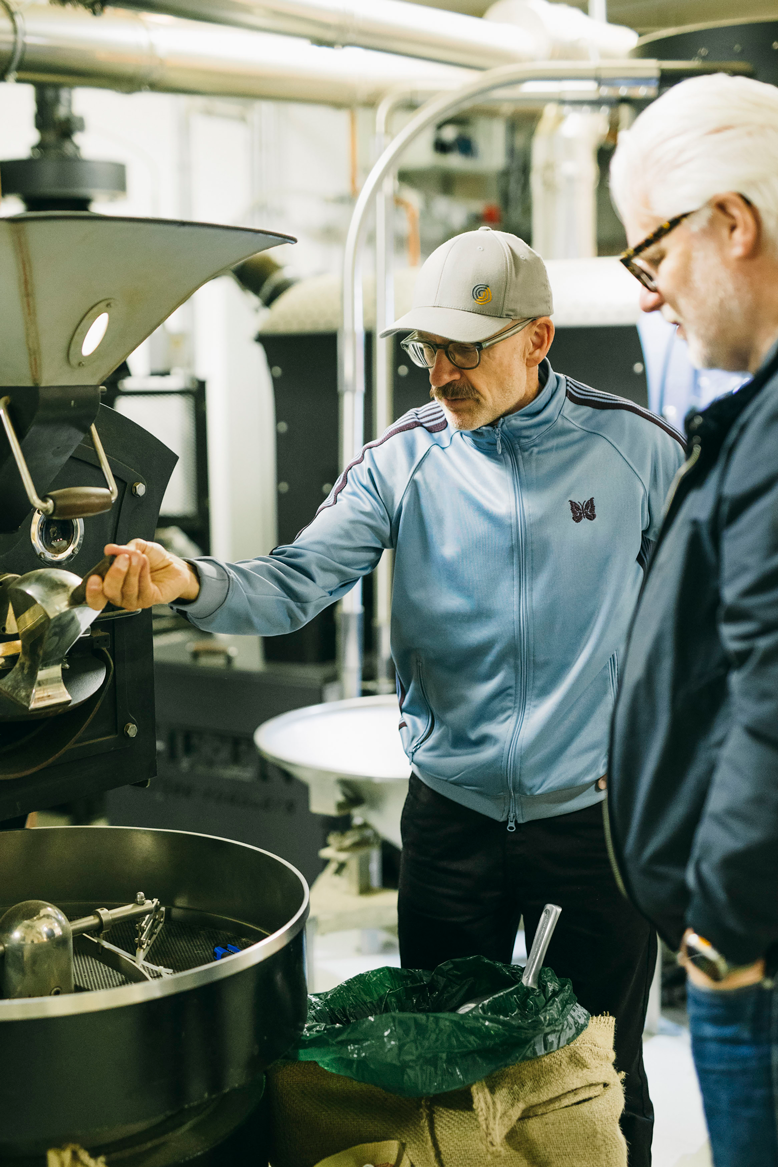
No, that came later. When I opened my first café, travelling was the opposite of what I did. I was in the shop every day, from morning until night. But the coffee market has evolved massively. Transparency became more important. We wanted to know where our products came from. For example, we sourced our milk directly from the farm from the outset. Later, we also wanted to work more closely with local farmers. We wanted to understand and take responsibility for each step of the process: cultivation, processing, roasting and preparation. If one of these steps doesn't work, the final product won't be good. That's exactly why our brand is called Rösterei Vier (Roastery Four).
How do you find your partner farms?
In the past, we simply drove there, knocked on the door and tried our luck. Trial and error, so to speak. Today, we know many of the farmers personally. Nevertheless, travelling remains indispensable. You can't do business via Zoom meetings because connectivity and the local network are so important. That's where you can see the quality of the produce and identify emerging trends. Take co-fermented coffees, for example, which we introduced this year. We discuss this within the team: I focus on sourcing, while my colleague Mateusz is responsible for quality in the roasting drum and in the cup. Taste is not a mathematical formula, so we have passionate but always constructive discussions.
How does climate change impact your work?
Very directly. Coffee has become dramatically more expensive. Extreme weather conditions, such as frost in Brazil or excessive rainfall in Vietnam, can sometimes double the price. On top of this, around 40 per cent of market participants trade coffee without ever having seen a bean. We feel the consequences of this on our own farm in Malawi, of course. The climate is visibly changing there, which affects yield and quality.
On the subject of Malawi, how did your work there come about?
Actually, it was through water, not coffee. We used to donate five pence per bottle of water sold to well projects. The first project in Nepal was a disaster: the well was never built and the money disappeared. I made up the difference privately and said, 'We'll continue, but we'll do it better.' Through my contacts, I came to Malawi, where I initially built wells – there are now over 40. Then, one day, a local farmer appeared in front of our colleague Tim with a zip-lock bag of green coffee. It was his only bag and he wanted it back. We brought the coffee back to Düsseldorf, roasted it here, and it was fantastic. Back in Malawi, we started working with other farmers. We fell head over heels in love with the region, with its rainforest, peacefulness and special atmosphere. In 2019, we took over a small lodge with the aim of creating a place where locals and expats could come together as equals. Today, this place is a café, restaurant and farm base. The quality improves every year. We can now compete with top countries such as Costa Rica.
You clearly work in partnership and collaborate closely. Why is that so important to you?
For us, coffee is also a way of making decisions: with every purchase, you help determine the kind of world you want to live in. We want everyone to benefit: the farmers, us, our customers and, of course, the environment. Growing coffee in the rainforest creates real added value. Good quality can only be achieved in a healthy ecosystem.
ABOUT MARTIN SCHÄFER
• since 1998 Entrepreneur in the café and coffee business
• since 2012 Well construction in Malawi
• 2016 Founding of the non-profit association Kumanga e.V. (water projects in Malawi)
• 2017 Opening of the café in Malawi
• 2019 Takeover of the lodge, Malawi
How do business relationships differ around the world?
Africa is not a homogeneous entity. Malawi, for example, is one of the poorest countries in the world, with low levels of education and little digital infrastructure. Tanzania, on the other hand, is a completely different place. South America, in turn, often has a more European character, while India is very different again. However, it depends much more on the people than the continent. An Indian farmer who has lived in New Zealand will work completely differently to someone who has always lived in India. Intercultural competence means understanding each country anew.
What is your biggest challenge at the moment?
Price fluctuations. The market is extremely volatile. While transport used to be the biggest challenge, nowadays it's more about reliability and planning security. Over the years, we have built up strong, trusting relationships. Many farmers have become friends. This helps us to navigate crises together.
So, where is your journey taking you?
Do you have a grand master plan? Size is not a criterion for us. Quality is our benchmark. Coffee is constantly evolving, both on the farm and in the cup. Every year, we discover something new. For us, evolution is more exciting than revolution.
What does Düsseldorf mean to you?
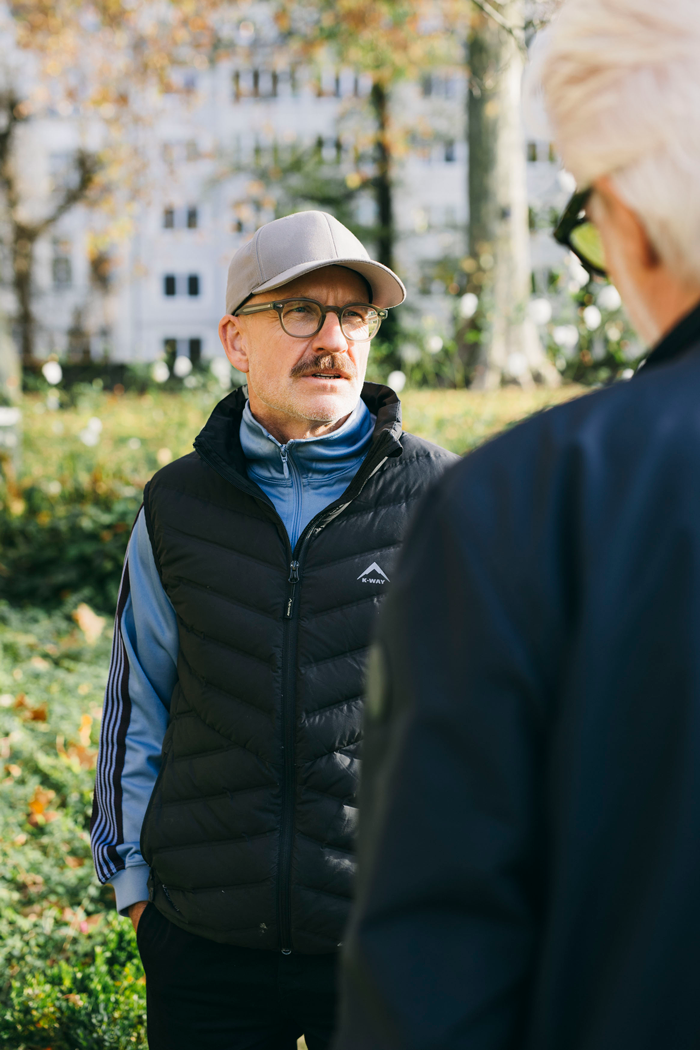
As someone from the Lower Rhine region, Düsseldorf has always felt like a natural home to me. We needed a big city for our concept and found the right location here at the right time. When you travel as much as I do, your perception of the city changes. Returning to Düsseldorf after months in the rainforest is almost a culture shock – but a pleasant one.
What advice would you give to young entrepreneurs who want to open a café?
Have a plan and stick to it! Things take time. If your concept is sound, stick with it and give it time to develop. Patience is an underestimated factor for success.
You have an unusual hobby that helps you switch off. How often do you go parachuting?
In a good month, as many as 20 times. •
Interview: Rainer Kunst
Words: Tom Corrinth
Pictures: Celine Al-Mosawi