
DEFENCE TECH AS STARTUP OPPORTUNITY
At the current 'turning point', Europe is seeking to reposition itself in terms of defence technology. The DefenseTech Inkubator.NRW in Düsseldorf has recently begun bringing start-ups, industrial companies and researchers together to develop new technologies and applications. These technologies are intended to prevent conflicts and promote protection and resilience.
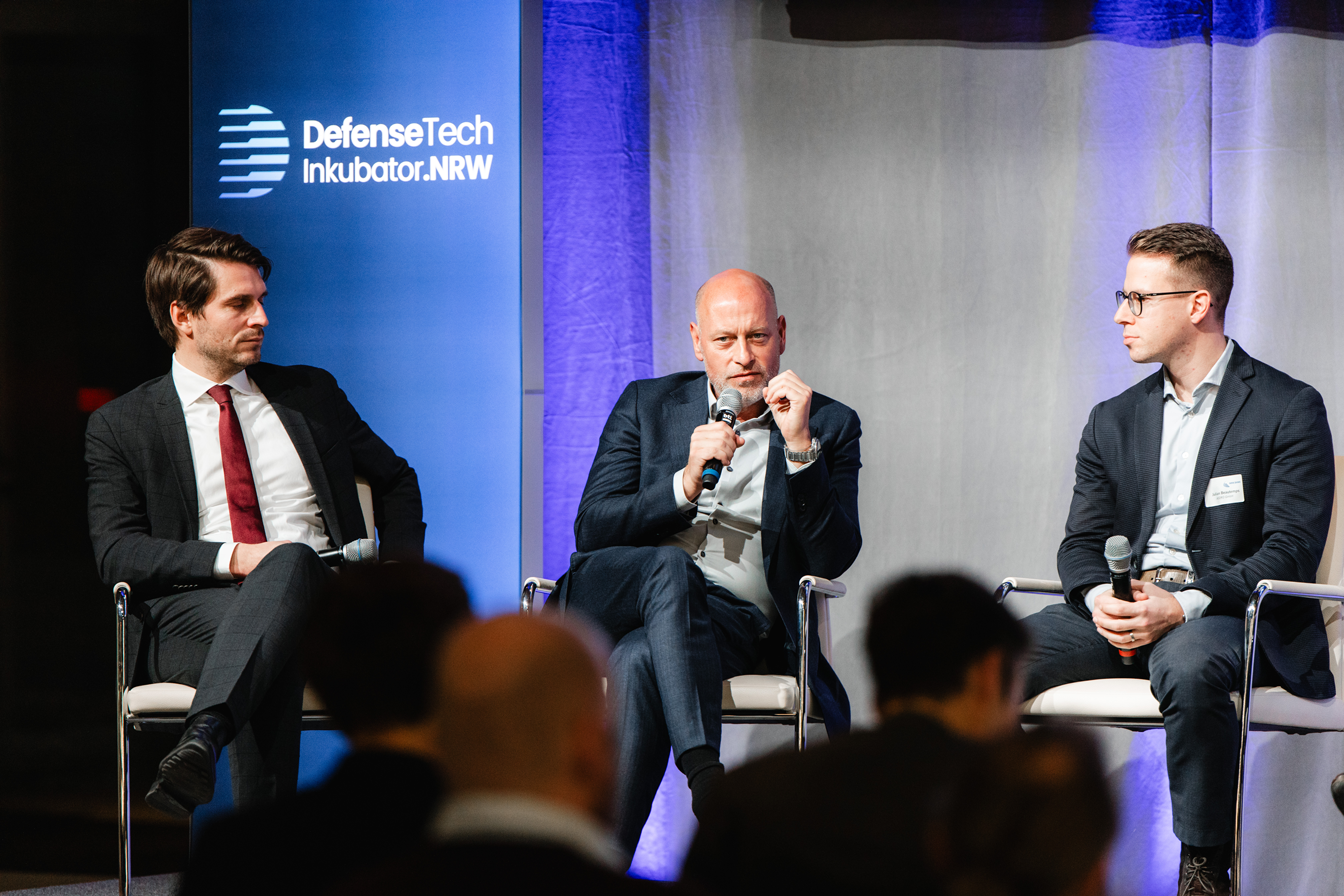
At the well attended kick-off meeting in January 2026 at NRW.Bank, experts also took to the podium to discuss the topic.
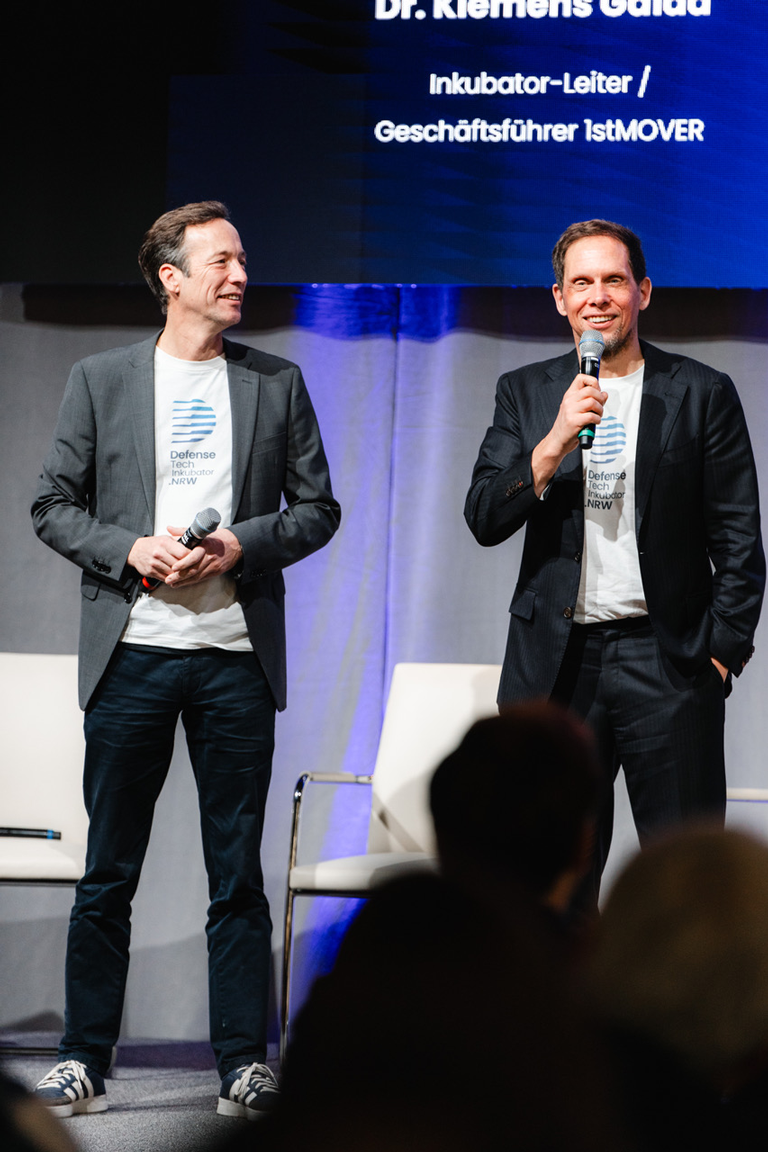
Dr Klemens Gaida and Peter Hornik at the launch event of the DefenseTech-Inkubator.NRW in early January 2026.
For decades, Europeans were accustomed to orderly power relations and geopolitical stability. Thanks particularly to their NATO partner, the USA, they often had a strong sense of security. However, this changed rapidly with the second term of Donald Trump's presidency, coupled with Russia's ongoing war of aggression against Ukraine, which has now been going on for over four years, and most recently the American-Israeli attack on Iran. And with it, awareness of Europe’s own defence capabilities. At the Munich Security Conference in February 2026, Mona Neubaur, the Deputy Minister- President of North Rhine-Westphalia, said the following during the presentation of a new technology and development centre for defence: 'For us, “turning point” is not just a buzzword, but a mission. We know that, to maintain peace, we must invest more specifically in our defence capabilities. The foundations for this are being laid today in research laboratories, factory halls and innovation centres. North Rhine-Westphalia has the industrial strength, the bright minds, and the will to take responsibility in this area.'
Dr Klemens Gaida and Peter Hornik share this view. Together with other experts, the two former managing directors of the Digital Innovation Hub Düsseldorf/Rhineland established the DefenseTech-Inkubator.NRW last year. The official launch event finally took place on 8 January 2026 at NRW.BANK under the patronage of Minister President Hendrik Wüst. ‘As the first incubator in North Rhine-Westphalia, we support innovative startups and spin-offs in the development of defence technologies. This includes dual-use solutions, i.e. technologies that can be used for both civilian and military purposes,’ Peter explains. The vision is to create a highly innovative, hightech SME sector in North Rhine-Westphalia that uses these technologies to protect freedom, peace and security without losing sight of its humanitarian principles. The focus is not on armament in the traditional sense, but on protection, resilience, and preventing violence before it arises.
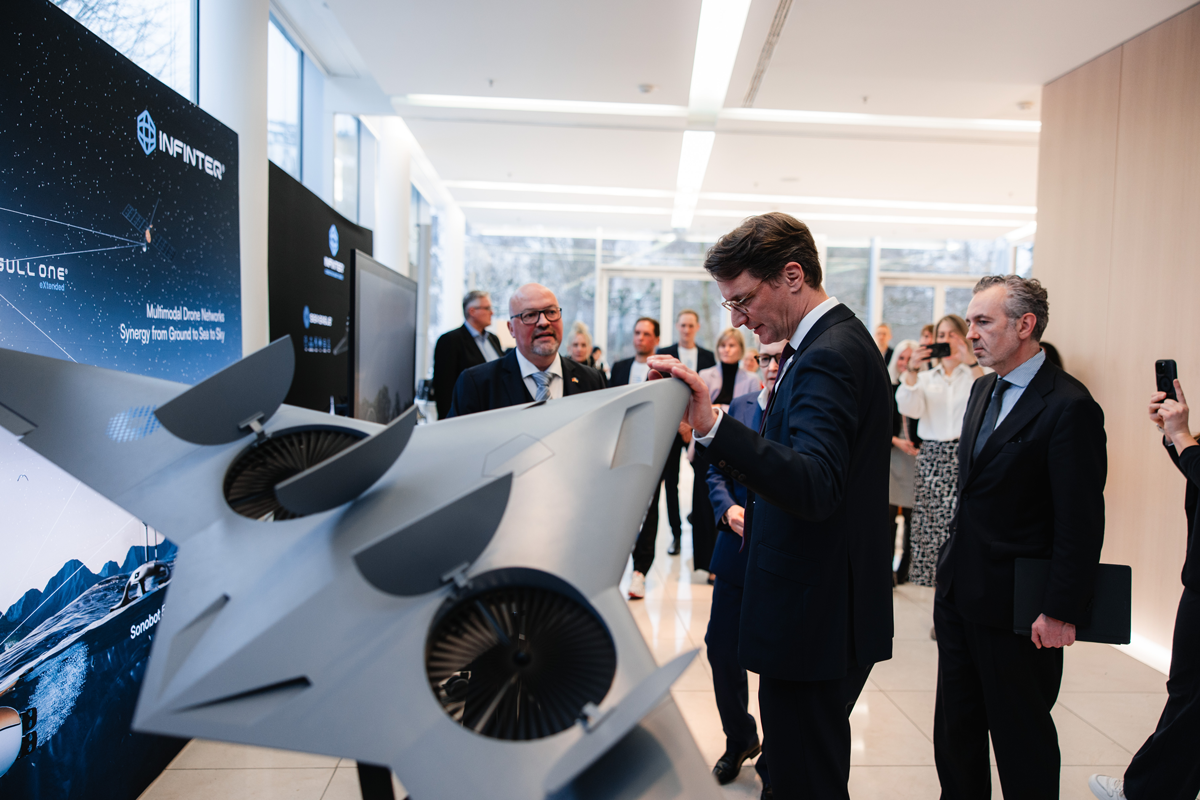
Der Schirmherr des DefenseTech-Inkubator.NRW Hendrik Wüst, Ministerpräsident von NRW, macht sich ein Bild von innovativer Verteidigungstechnologie.
The incubator now offers selected startups comprehensive support in the form of mentoring, peer-to-peer learning, access to military facilities, industrial companies and venture capital providers, a presence at events and trade fairs (see info box Xponential) and co-working spaces, all in regular six-month programmes known as 'batches'. ‘We see the incubator as a bridge builder. In a previously complex and highly regulated market environment, we provide market expertise, financing opportunities, and a network that young companies in the defence sector in North Rhine-Westphalia did not have access to before,' adds Klemens Gaida.
To gain an overview of the North Rhine-Westphalia market's potential, the incubator team conducted a thorough survey in summer 2025. Around 80 defence tech startups from a wide range of fields took part. ‘As expected, one of the findings was that most startups are at a very early stage. However, interestingly, there are also afew larger, well-established startups that are already active in the civilian sector. They now want to expand into the defence market in a conscious effort to pursue dual use,' Klemens Gaida explains. The motives for this are also interesting. As well as using existing technologies in a new market environment (59 per cent of respondents) and gaining access to new markets and customers (54 per cent), 53 per cent of the startups surveyed stated that they want to actively contribute to securing our democracy. The first startup cohort is currently underway and is already bursting with diversity. For example, it includes young companies from the fields of autonomous vehicles, cyber security, drone defence, and darknet monitoring. One of the startups manufactures probes that can be fired beneath the Arctic ice for observation purposes.
The incubator has acquired technical expertise in various ways. For instance, the core team includes two former Bundeswehr officers. Selected partner companies, such as IT and business consultancy firm CGI Germany, commercial law firm Heuking, and multi-technical services company Spie, provide support in the form of technological and legal expertise, as well as services that are specific to the defence sector. An eight-member advisory board rounds off the setup, including Christian Ziach from High Tech Gründerfonds in Bonn. The former air force officer, aerospace engineer and experienced deep tech investor recognises the significant potential of modern, networked defence technologies in North Rhine-Westphalia. 'The civilian economy benefits from increased demand and faster development cycles, while dual-use solutions from defence technology provide impetus for efficiency and scaling in civilian applications — a mutual driver of innovation. If we combine the current increased security and defence budgets with research, test fields and procurement wisely, we can not only close capability gaps, but also increase industry productivity and grow our way out of the slump. This is crucial to securing long-term prosperity and competitiveness.’
NEW NRW TECHNOLOGY AND DEVELOPMENT CENTER STRENGTHENS DEFENCE CAPABILITIES
At the 2026 Munich Security Conference, Deputy Minister-President of North Rhine-Westphalia Mona Neubaur signed a letter of intent for the Production Launch Centre Defence (PLCD). The aim of the planned technology and development centre is to forge closer links between business, research and innovation clusters in North Rhine-Westphalia and to strengthen the industrial and technological basis for security and resilience in Germany and Europe. The first key partners are the Düsseldorf-based defence and technology group Rheinmetall, lightweight construction specialist Mubea as well as Lockheed Martin, global technology company for aviation and defence. DefenseTech-Inkubator.NRW will also benefit from this: ‘The PLCD will be a perfect point of contact for our incubator start-ups,’ says Peter Hornik.
Recognising that DefenseTech is unlikely to be a short-term trend, Peter Hornik and Klemens Gaida's team has ambitious plans for the coming years. By 2028, they intend to prepare at least 50 startups and spin-offs from North Rhine-Westphalia for the future with the support of over 20 venture capital financing deals. If more partner companies and financiers get involved, even more will be possible. North Rhine-Westphalia has a very good chance of becoming the second German DefenseTech hotspot after Bavaria. Ultimately, however, the aim is to establish a networked European community. 'We advocate open innovation and diversity in the markets because it helps the German and European economies. In doing so, we must ensure that no oligopolies arise in the defence market,’ says Klemens Gaida. Peter Hornik adds, ‘I believe that, as a society, we are now setting the course for Europe in the coming decades, and the incubator is just one small part of that. Ultimately, what matters is ensuring that we can continue to live in freedom and peace, just as we have done before.' •
SECOND EDITION OF XPONENTIAL EUROPE
From 24 to 26 March 2026, around 360 exhibitors from 43 countries showcased autonomous systems and robotics at the Messe Düsseldorf. XPONENTIAL Europe focused on drones for military and civilian use, protecting critical infrastructure, and integrating autonomous systems, robotics, and cybersecurity into production, mobility, logistics, and many other industrial applications. Many exhibitors used the trade fair as an opportunity to raise the profile of North Rhine-Westphalia as a leading location for autonomous technologies. More Informations: xponential-europe.de
Words: Tom Corrinth
Pictures: Paul Caruso