
JOINING FORCES FOR THE CITY OF TOMORROW
In many municipalities, the departments responsible for urban planning and economic development often find it difficult to agree on land use, responsibilities and priorities. In Düsseldorf, however, this has resulted in a successful joint project.
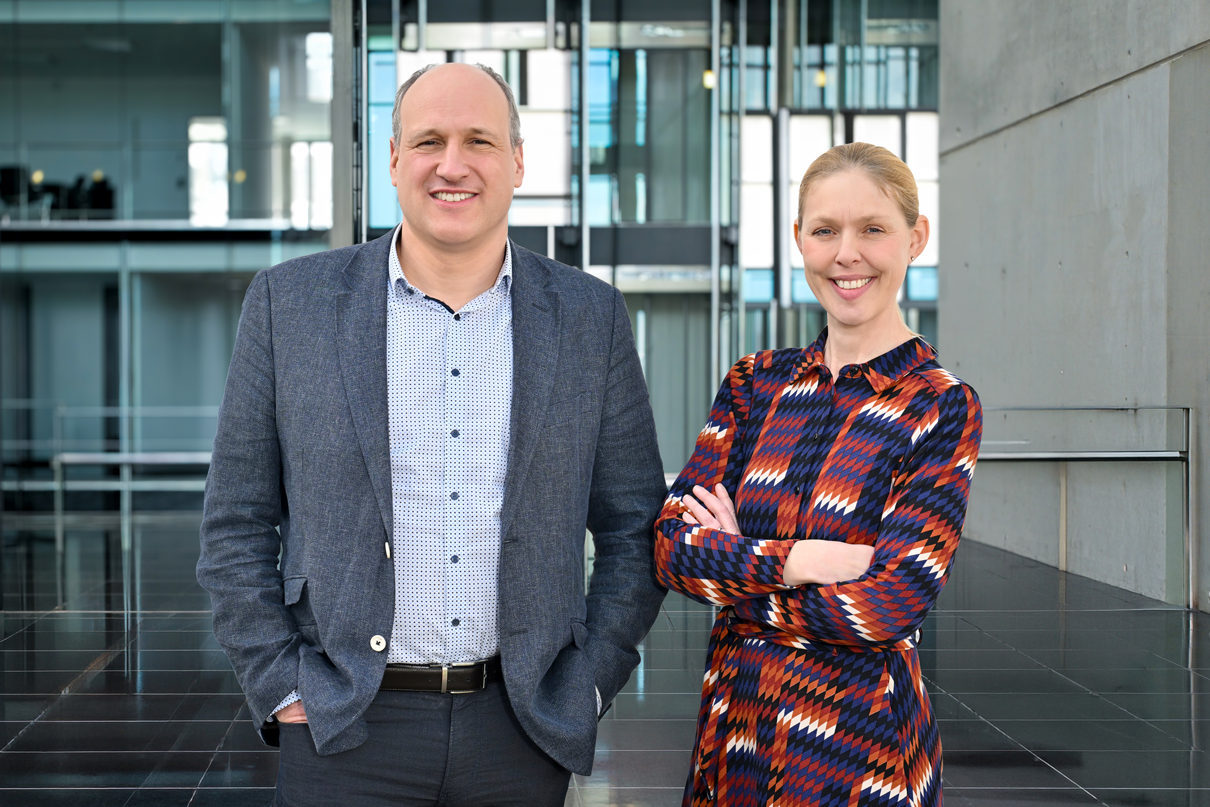
Kai Fischer, Head of the City Planning Office, and Theresa Winkels, Head of the Economic Development Agency, are joining forces for Düsseldorf.
At its heart is the 'Master Plan Industry’ (see p. 6) – a strategic framework that the two departments collaborated on and continue to contribute to jointly. This is based on the core zone map, which secures areas for industry and commerce in the long term. In one of Germany's most densely populated cities, this represents a significant political and economic commitment. 'We are not just looking at the next two or three years; we are thinking in terms of decades,' emphasises Theresa Winkels, head of the Düsseldorf Economic Development Agency. This framework provides guidance, especially in difficult economic times when owners are considering alternative uses, such as residential construction.
Rather than making decisions on a case-by-case basis, both offices rely on a structured process. This involves workshops with politicians and companies, close coordination with the Chamber of Industry and Commerce, and clear political decisions. The discussion takes place within the system, not behind closed doors.
One example is the transformation of the former Vallourec works. Despite the desire for residential construction, the focus remained on commercial use. Instruments such as pre-emptive rights statutes and avoidance agreements ensure that urban development goals and investor interests are aligned. ‘Investors in Düsseldorf can always rely on coordinated decisions,’ says Kai Fischer, head of the Düsseldorf City Planning Office.
At the same time, the alliance is not dogmatic. Each site is reviewed regularly. Has the surrounding area changed? Is residential development encroaching? Where would it make sense to adapt? The decisive factor is achieving the right balance, i.e. ensuring that there is still sufficient industrial and commercial space overall. After all, modern production is more compact, multi-storey and efficient. This creates scope for manoeuvre without compromising the industrial base. Protecting existing businesses is particularly important here. New residential developments, for example, can result in protection claims that lead to tighter noise or traffic restrictions, which could jeopardise investments. 'We are securing not only land, but also the future viability of the companies located there,' says Theresa Winkels.
This close integration is also reflected in the company's public image: trade fair presentations, real estate formats and other industry events are designed jointly in terms of content. Ultimately, it's about much more than just space management. ‘Living and working belong together in a European city’ is the shared credo. Furthermore, they say, ‘We want to preserve the urban mix and manage conflicts of use in such a way that production, living and leisure can coexist permanently.’ This balancing act is succeeding relatively smoothly in Düsseldorf for good reason. Achieving this is the result of a culture of coordination and a master plan not just drawn up on paper, but put into practice. •
Words: Tom Corrinth
Pictures: Landeshauptstadt Düsseldorf/ Michael Lübke