“I TRY TO LIVE IN A WAY THAT IS ANYTHING BUT DOGMATIC”
He develops property, has been collecting contemporary art for decades and, with the Philara Collection, has created a venue that has been shaping Düsseldorf’s art scene. To mark the exhibition space’s tenth anniversary, Gil Bronner talks about his passion for collecting, entrepreneurial decisions and the responsibility that comes with private initiatives.
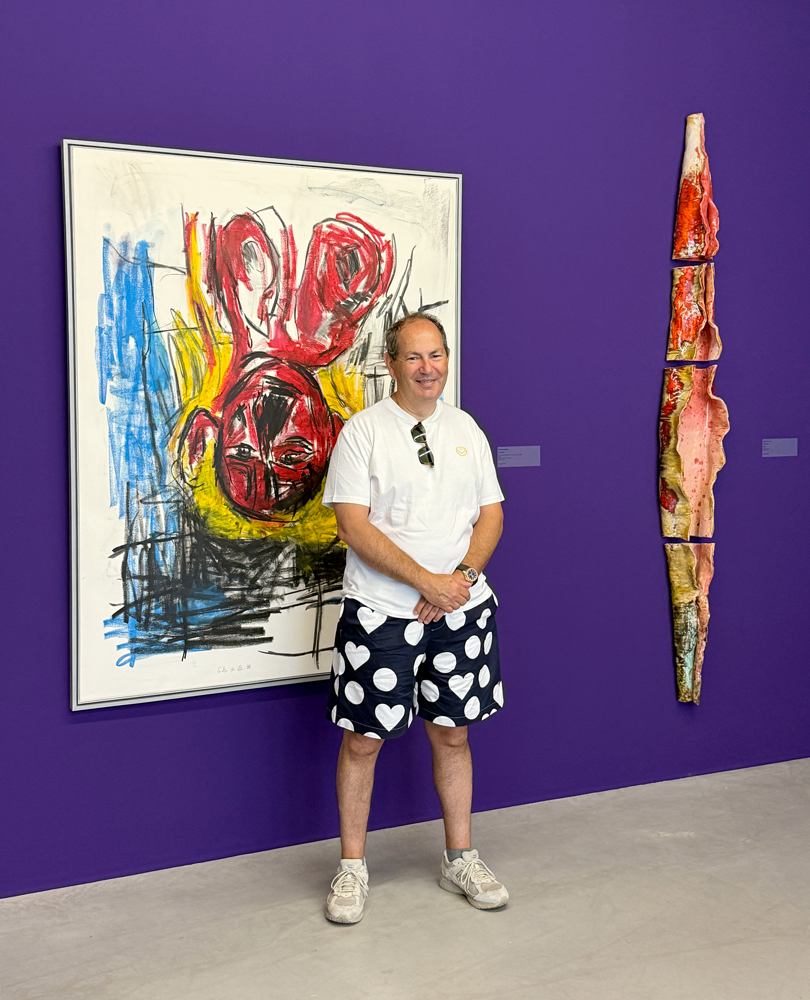
Gil Bronner vor Georg Baselitz, Titel unbekannt (16.VII.1988), 1988, und Katja Tönnissen, DETOX 17, 2019
“If you like, we can crop the trousers,” says the photographer. Gil Bronner looks down at himself: dark blue shorts with white dots and hearts. “No need – I stand by them.” He seems amused at the press event at the Philara Collection. Behind him, against the lilac-coloured wall, hangs a Georg Baselitz that was already part of the collection of his parents, Cary and Dan Georg Bronner. They passed on their enthusiasm for art to him. Together with his wife Anat, he has pursued this passion to such an extent that their collection now comprises around 2,000 works. Parts of it are on public display at the Philara Collection, a specially converted former industrial glassworks in a Flingern courtyard. The collection is celebrating its tenth anniversary this year with the exhibition ‘House of Balagan’. Balagan means chaos. A joyful chaos, full of improvisation and vitality. The name can be seen as a reference to the criteria the couple set for their acquisitions. Unlike other collections, there is no thematic focus or emphasis on specific artists. The only thing that matters is quality. “I try to live in a way that is anything but dogmatic,” says Gil Bronner.
ICONS REMAIN ICONS
The collection’s first home was one of Bronner’s earliest properties – a former Leitz ring-binder factory in Reisholz, where he set up artists’ studios. “Down in the basement, we had a storeroom where we and the in-house artists held exhibitions.” The collection grew just as the portfolio of property developer Gil Bronner did. He now counts 1,000 units among his holdings. When asked about the similarities between the art and property markets, Bronner says, “Absolutely top-tier properties such as the Drei-Scheiben-Haus retain their value because they are iconic. The same applies to Picasso, Gerhard Richter and other icons of the post-war era.” The buying process, however, is different. Whilst he often buys art on impulse, buying property is a much more rational process. Most of the time at least. “I carried out my first banking transactions at Brehmplatz and then, at some point, bought this property. It’s a bit like an adult buying the car they used to play with as a child in Matchbox format,” he says with a smile.
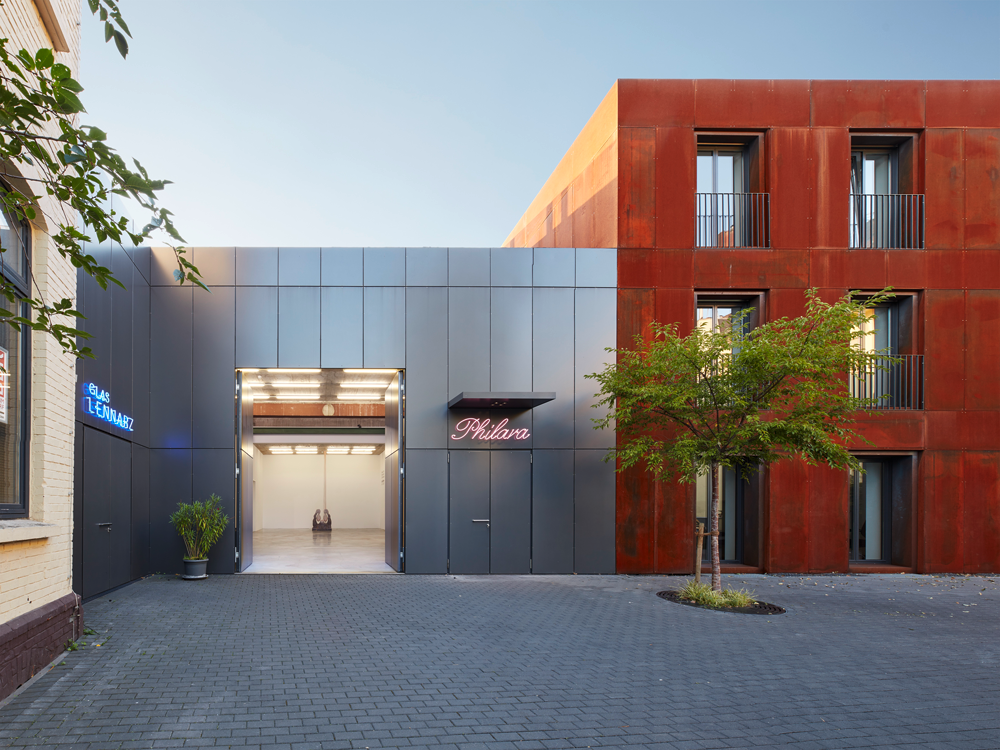
The Philara Collection is situated right next to the Filmwerkstatt Düsseldorf, the Wim Wenders Foundation and the Bulle Bistro.
A HOME FOR THE COLLECTION
When the collection outgrew the old Leitz factory, Bronner converted the former glassworks in Flingern into a museum. 1,700 m2 of exhibition space, with ceilings in some places over nine metres high, plus outdoor areas offering space for sculptures. “I was worried that the collection wouldn’t measure up to the spaces. That’s why I started buying large-scale installation pieces. But then again, I was a novice when it came to building a new museum.”
After 10 years, 35 temporary exhibitions and ten presentations of the permanent collection, the Philara Collection now employs four staff members plus freelance guides and security personell. Hannah Niemeier has been the artistic director since March 2026 . She curated the current anniversary exhibition. “Together with my wife and the curatorial team, we generally make decisions collaboratively. However, we leave the details of the hanging to the team.” Gil Bronner has curated just one room on his own. It is obvious that this room is different. Purple walls, densely hung with artworks. One of the works on display is by Friedrich Kunath, whose solo exhibition was the first one held at the Philara Collection at its Flingern location. Alongside the painting by Georg Baselitz, a ceramic work by the Düsseldorf-based artist Katja Tönnissen provides a female counterpoint. “Ensuring a balance between male and female artists was the only conscious decision I made in my collection.” When the team took stock seven years ago, the proportion of female artists in the collection stood at 35 per cent. “I was genuinely shocked, because I would have thought it would be equal.” From then on, greater emphasis was placed on female artists. Today, the figure stands at around 55 per cent. “I think it’s important that there is a balance.”
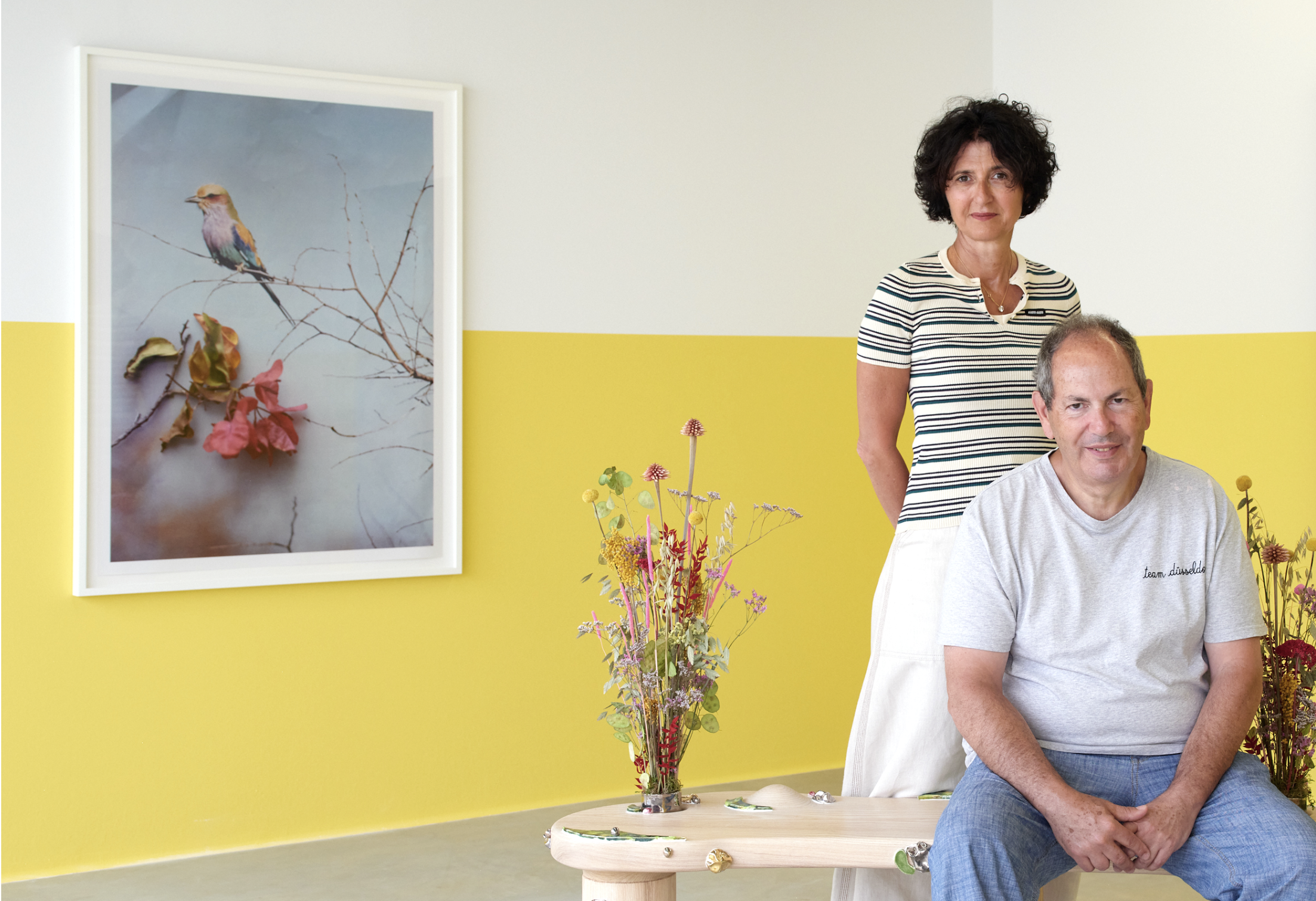
Anat Bronner is an art historian, Gil Bronner a property developer – they have been collecting art since the 1990s.
UNDOGMATIC, YET CONSISTENT
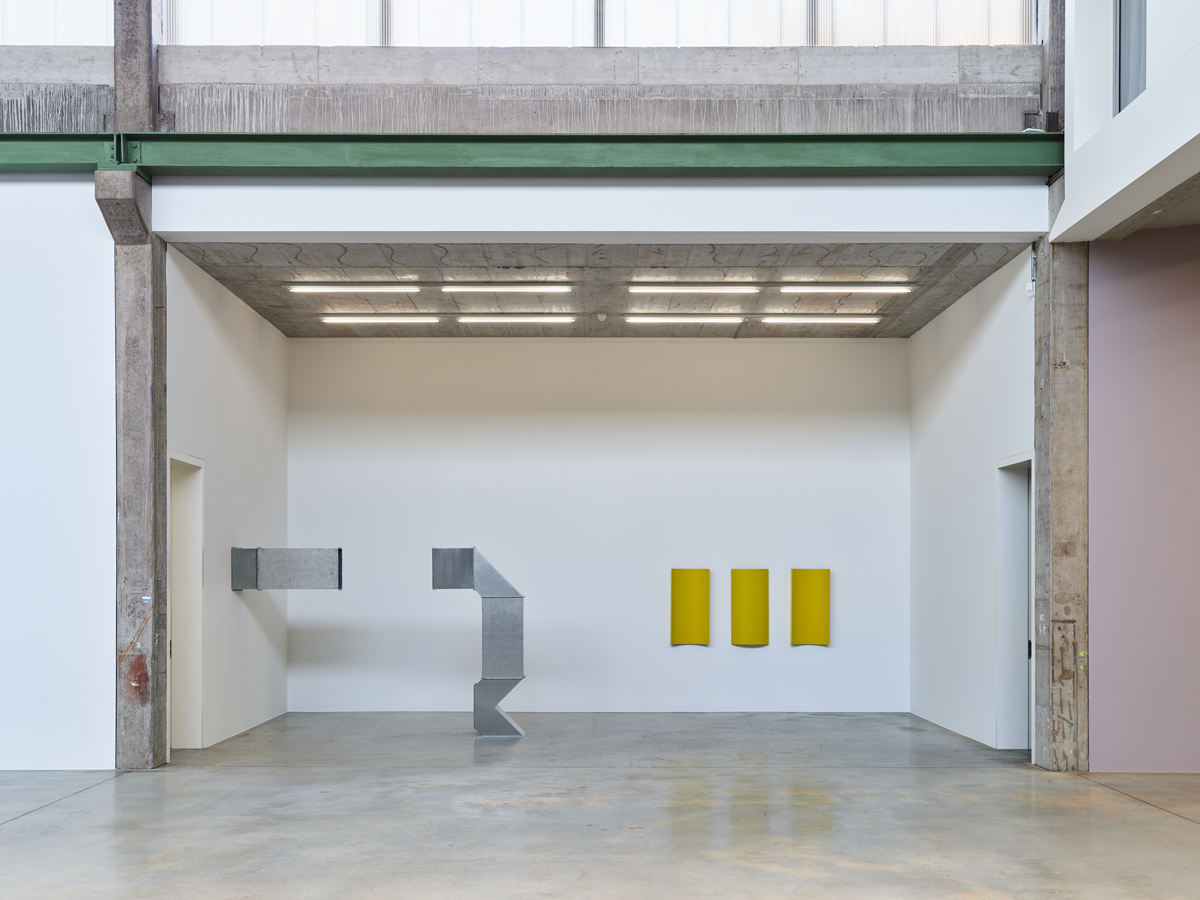
The anniversary exhibition ‘House of Balagan’ showcases over 100 works from the collection, which comprises around 2,000 pieces.
Bronner derives a sense of responsibility from being an entrepreneur. The Philara Collection can be visited on a ‘pay what you wish’ basis. It is of great significance to the artists and gallerists. Bronner is also actively involved with the Kunstpalast members association. He has been on the board since 2017 and has served as chairman since 2019. “I was actually ‘shanghaied’.” The term ‘shanghaiing’ refers to the practice of getting people drunk in harbour taverns, so that they would wake up the next morning on board a ship that had already set sail and be forced to work there. “Something similar happened to me with the Kunstpalast. Felix Krämer (Director of the Kunstpalast, editor’s note) persuaded me to take on this role. I was rather reluctant at first. But nothing is more enjoyable than success. And we’re phenomenally successful. When I took over, we had fewer than 700 members, and now we’re aiming for 7,000.”
He considers private commitment to art and culture to be desirable. Düsseldorf offers fertile ground for this: “The city attracts people with an interest in culture, such as Julia Stoschek and Monika Schnetkamp (founders of the private exhibition venues Julia Stoschek Collection and KAI 10, editor’s note). And because there are so many museums and so much art on display, more people get involved than in other cities where there isn’t as much on offer.”
Plans for the future of the Philara Collection? “More exhibitions from the collection again. The response to House of Balagan was extremely positive.” What the long-term future holds – and whether the Bronners’ children, Philip and Lara, after whom the collection is named, will take over – remains uncertain. “If the collection isn’t broken up at some point, it may well be that in 100 years’ time it will include some outstanding artists – artists that no one would have ever suspected, and who will by then be very, very valuable. But it may also be that art, much like Persian carpets, will one day be completely overlooked. I don’t believe that will happen, but you never know.” As you leave the exhibition, your catch sight of The Ringbinder Circle by Ignacio Uriarte. 128 Leitz ring binders form a circle – there it is again, the Matchbox car. This time, it’s the other way round – the real car, in the shape of the Leitz binder factory, was there first. Full-circle moments seem to be a thing for Gil Bronner. •
Text: Lisa Maria Kunst
Pictures: Lisa Maria Kunst, Paul Schöpfer, Kai Werner Schmidt, Anat und Gil Bronner zwischen Arbeiten von Margarete Jakschik und Matthias Weischer auf einer Bank von Michaela Yearwood-Dan, Kai Werner Schmidt, Charlotte Posenenske Vierkantrohre Serie D 1967–2016 Reliefs Serie B 1967–2010 Courtesy of the artist & Sammlung Philara, Düsseldorf Autorisierte Rekonstruktion mit Zertifikat vom Nachlass